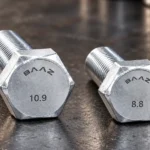

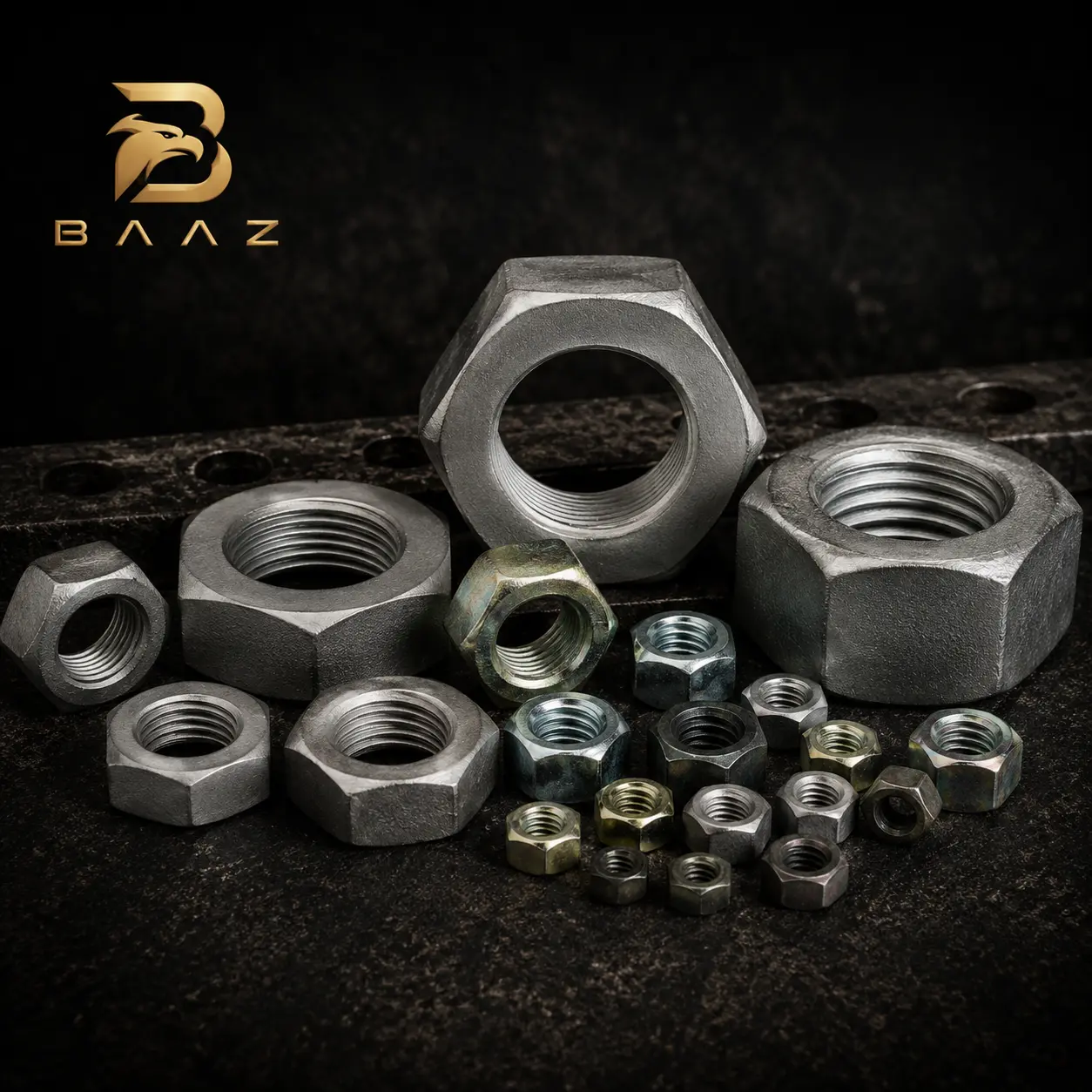
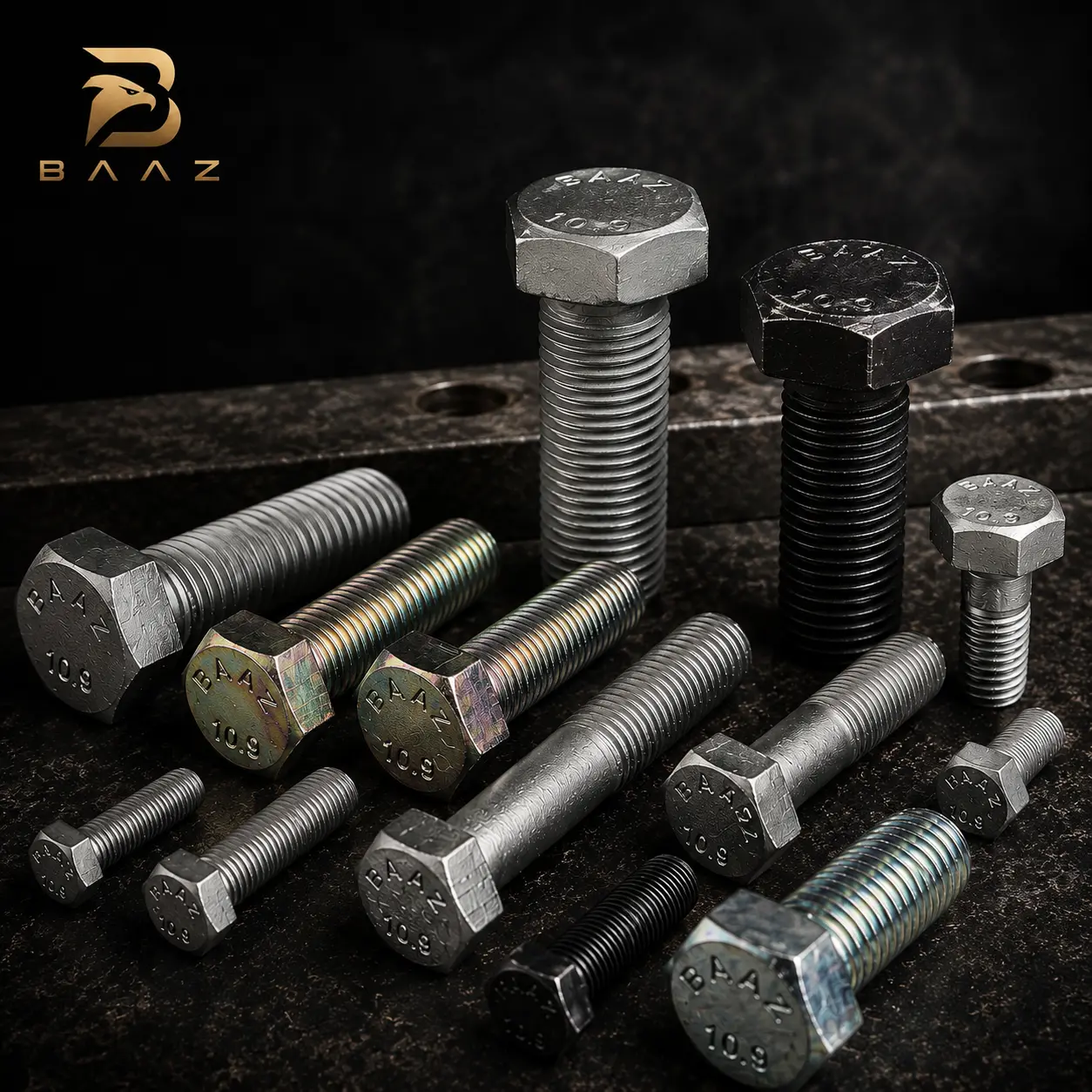
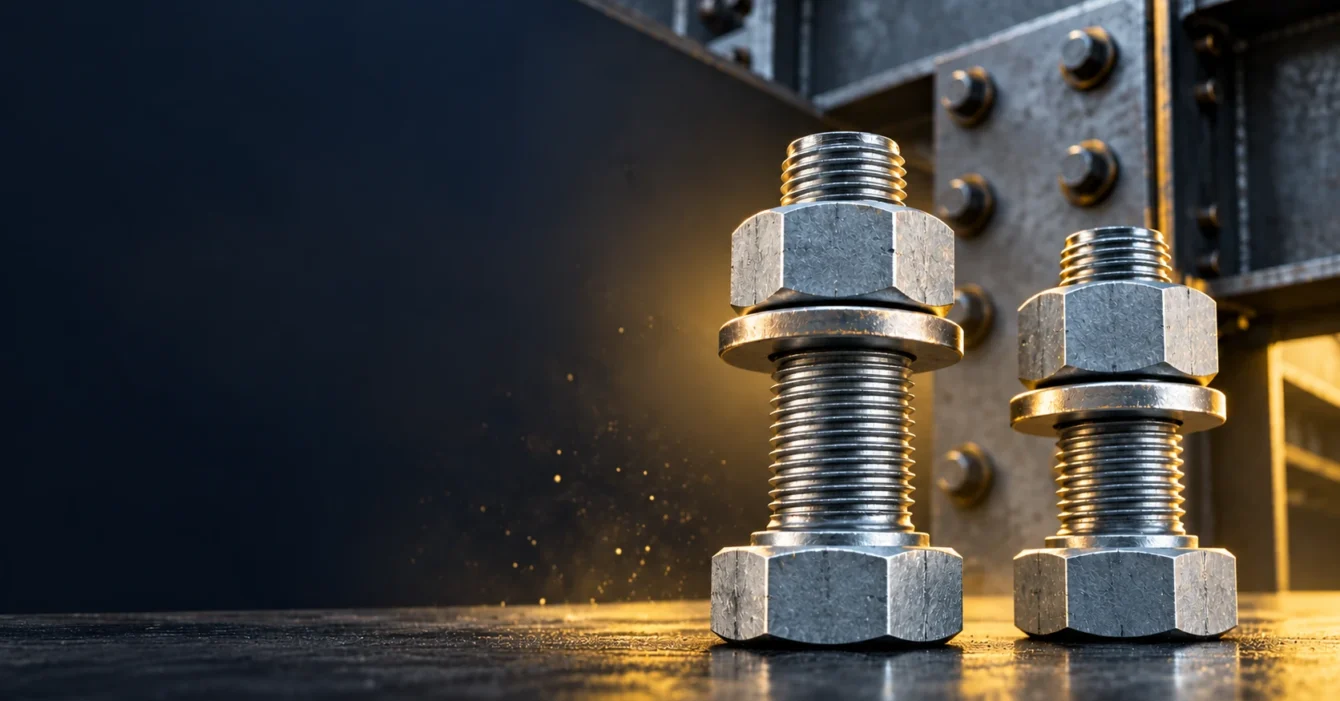
HR bolts (EN 14399-3) and HV bolts (EN 14399-4) are the two hexagon-head preloaded bolt systems in the EN 14399 series. Both are designed for the same minimum preload, 0.7 × fub × As, and both are tightened using the methods in EN 1090-2. The differences are practical: HR assemblies are available in property class 8.8 or 10.9, HV assemblies in 10.9 only, and each system has its own component standards and markings. At the same size and class, neither is stronger. Bolt, nut and washer must come from one tested lot, and HR and HV parts must never be mixed. Specify whichever system your project documents name.
What EN 14399 Covers
EN 14399 is the European standard series for high-strength structural bolting assemblies for preloading. These assemblies are used in slip-resistant (friction-grip) connections in bridges, buildings, towers and industrial steelwork, where the bolt is tightened to a controlled tension so the joint carries load by friction between the plates.
The series is split into parts. Parts 3 and 4 are the two you will compare most often when you order hexagon-head bolts:
| Part | What It Covers |
|---|---|
| EN 14399-1 | General requirements for all systems |
| EN 14399-2 | Suitability testing for preloading |
| EN 14399-3 | System HR: hexagon bolt and nut assemblies |
| EN 14399-4 | System HV: hexagon bolt and nut assemblies |
| EN 14399-5 and -6 | Plain washers and plain chamfered washers |
| EN 14399-7 | System HR: countersunk head bolt and nut assemblies |
| EN 14399-8 | System HV: hexagon fit bolt and nut assemblies |
| EN 14399-9 | Direct tension indicators for HR and HV assemblies |
| EN 14399-10 | System HRC: assemblies with calibrated preload |
If you are still deciding between a structural assembly and a general-purpose or pressure-service fastener, our guide to ASTM B7 studs vs EN 14399 explains where each standard applies
What Are HR Bolts (EN 14399-3)?
System HR is covered by EN 14399-3. HR assemblies consist of a hexagon-head bolt, a matching nut and washers, supplied together as one tested set. The HR system is available in two property classes:
- Property class 8.8 bolts, paired with class 8 nuts
- Property class 10.9 bolts, paired with class 10 nuts
The ability to use class 8.8 makes HR the more flexible system where the design preload does not need the full capacity of a 10.9 bolt. HR bolts and nuts are marked with the letters HR, the manufacturer’s identification mark and the property class.
What Are HV Bolts (EN 14399-4)?
System HV is covered by EN 14399-4. HV assemblies are also supplied as a matched bolt, nut and washer set, but the system is limited to property class 10.9 bolts with class 10 nuts. HV components are marked with the letters HV, the manufacturer’s mark and the property class.
HV and HR have different historical roots: HV follows the German DIN tradition for high-strength preloaded bolts, while HR follows British practice. Both were brought together in EN 14399, so today they sit side by side under one European standard, each with its own dimensional tables and component requirements.
HR vs HV: Side-by-Side Comparison
| Aspect | HR (EN 14399-3) | HV (EN 14399-4) |
|---|---|---|
| Product | Hexagon bolt and nut assembly | Hexagon bolt and nut assembly |
| Property Class (Bolt) | 8.8 or 10.9 | 10.9 only |
| Property Class (Nut) | 8 (with 8.8) or 10 (with 10.9) | 10 |
| Design Preload | Fp,C = 0.7 × fub × As | Fp,C = 0.7 × fub × As |
| Component Marking | HR, manufacturer mark, property class | HV, manufacturer mark, property class |
| Suitability Testing | EN 14399-2, with declared k-class | EN 14399-2, with declared k-class |
| Tightening Methods | Torque, combined, DTI (EN 14399-9) | Torque, combined, DTI (EN 14399-9) |
| Head and Nut Dimensions | Per EN 14399-3 tables | Per EN 14399-4 tables |
| Interchangeable With the Other System? | No | No |
The takeaway: at the same size and the same property class (10.9), HR and HV deliver the same design preload. The decision usually comes down to what the specification names, whether you need the 8.8 option, and which system your supplier tests and certifies as a full assembly.
Preload Values for HR and HV Bolts
For both systems, the design preload is Fp,C = 0.7 × fub × As, where fub is the bolt’s ultimate tensile strength (800 MPa for class 8.8, 1000 MPa for class 10.9) and As is the tensile stress area. These are the standard values for common sizes:
| Bolt Size | Stress Area As (mm²) | Class 8.8 Fp,C (kN) | Class 10.9 Fp,C (kN) |
|---|---|---|---|
| M12 | 84.3 | 47 | 59 |
| M16 | 157 | 88 | 110 |
| M20 | 245 | 137 | 172 |
| M22 | 303 | 170 | 212 |
| M24 | 353 | 198 | 247 |
| M27 | 459 | 257 | 321 |
| M30 | 561 | 314 | 393 |
| M36 | 817 | 458 | 572 |
Class 8.8 values apply to HR assemblies only, because HV is a 10.9 system. If you need a refresher on what 8.8 and 10.9 actually mean, see Bolt Grades Explained.
How HR and HV Bolts Are Tightened
Both systems are installed under the preloading rules of EN 1090-2, which is the execution standard for steel structures. The accepted methods include:
- Torque method: tighten to a calculated torque using a calibrated wrench.
- Combined method: apply a first torque, then a specified further rotation.
- Direct tension indicator method: use DTI washers to EN 14399-9 to confirm the bolt tension visually.
Torque-based methods rely on a known relationship between torque and bolt tension. That is why EN 14399 assemblies are supplied with a declared k-class from the suitability tests, and why the method you choose must match the k-class shown on the certificate. Always confirm the method and the required k-class against the project specification before you order.
Why You Cannot Mix HR and HV Parts
An EN 14399 assembly is not simply a bolt, a nut and a washer from the shelf. The standard requires the whole set to be tested for its suitability for preloading, and the components are designed to work together. That means:
- Do not combine an HR bolt with an HV nut, or the reverse.
- Do not combine bolts, nuts and washers from different manufacturers or different production lots.
- Do not substitute standard ISO 4014 bolts or ISO 4032 nuts into a preloaded joint.
For projects in the European Union, EN 14399-1 assemblies are also expected to carry CE marking with a Declaration of Performance. Keep the lot certificates and traceability records with the delivery.
How to Choose Between HR and HV
-
What does the project specification name?If the drawings or specification state HR or HV, supply exactly that. This settles most orders.
-
Do you need property class 8.8?Only HR is available in 8.8. If the design calls for 8.8 preloaded bolts, HR is the system.
-
Is the design basis Eurocode with an installer already working to one system?Staying with one system across a job keeps stores, tooling and inspection simple.
-
Which tightening method will the fabricator use?Confirm the k-class and the method (torque, combined or DTI) so the delivered assembly suits the installation.
-
Can your supplier certify the complete assembly?Ask for bolt, nut and washer from one lot with EN 10204 3.1 test certificates. Our EN 14399 structural bolt assemblies are supplied this way.
On domestic Indian projects, HSFG bolts to IS 3757 are common; EN 14399 is typically specified for export work or where the design basis is European. For a comparison of preloaded bolts with ordinary bolts, read HSFG Bolts vs Regular Bolts.
Common Mistakes to Avoid
- Assuming HV is “stronger” than HR. At the same size and property class, the design preload is the same.
- Ordering HV when the specification calls for 8.8 preloaded bolts, since HV is a 10.9 system.
- Mixing HR and HV bolts, nuts or washers, or sourcing the parts from different suppliers.
- Ignoring the k-class and then choosing a torque method that the certificate does not support.
- Reusing preloaded bolts after full tightening, or treating a lubricated assembly as if it were dry.
- Accepting a delivery with no lot traceability or test certificates.
Frequently Asked Questions
Is an HV bolt stronger than an HR bolt?
Not at the same size and property class. Both systems are designed for the same minimum preload, 0.7 × fub × As. The main practical difference is that HR is available in 8.8 and 10.9, while HV is 10.9 only.
Can I use an HR bolt with an HV nut?
No. EN 14399 assemblies are tested and certified as a matched set from one manufacturer lot. Mixing HR and HV components, or parts from different lots, voids the assembly’s suitability for preloading.
What is the difference between EN 14399-3 and EN 14399-4?
EN 14399-3 covers system HR hexagon bolt and nut assemblies in property classes 8.8 and 10.9. EN 14399-4 covers system HV hexagon bolt and nut assemblies in property class 10.9. Both are for preloaded, slip-resistant structural connections.
Which system should I specify for my project?
Use whichever system the project specification names. If it only says “EN 14399 preloaded bolts”, confirm HR or HV, the property class, the k-class and the tightening method with the engineer before you order.
Conclusion
HR and HV bolts are two routes to the same goal: a reliable, controlled preload in a slip-resistant steel connection. HR (EN 14399-3) offers both 8.8 and 10.9, while HV (EN 14399-4) is a 10.9 system. At the same class and size they carry the same design preload, so the right choice is the one your specification names, supplied as one complete, certified assembly.
Before you place an order, confirm the system, property class, k-class, tightening method and certification requirements. That short checklist prevents most of the delays and rejections that happen on site.
Standards referenced: EN 14399-3 (System HR) and EN 14399-4 (System HV) on the BSI Shop.
Need EN 14399 Bolt Assemblies?
Baaz Fasteners manufactures EN 14399 structural bolt assemblies with matched bolts, nuts and washers, full material certification and traceability on every batch.